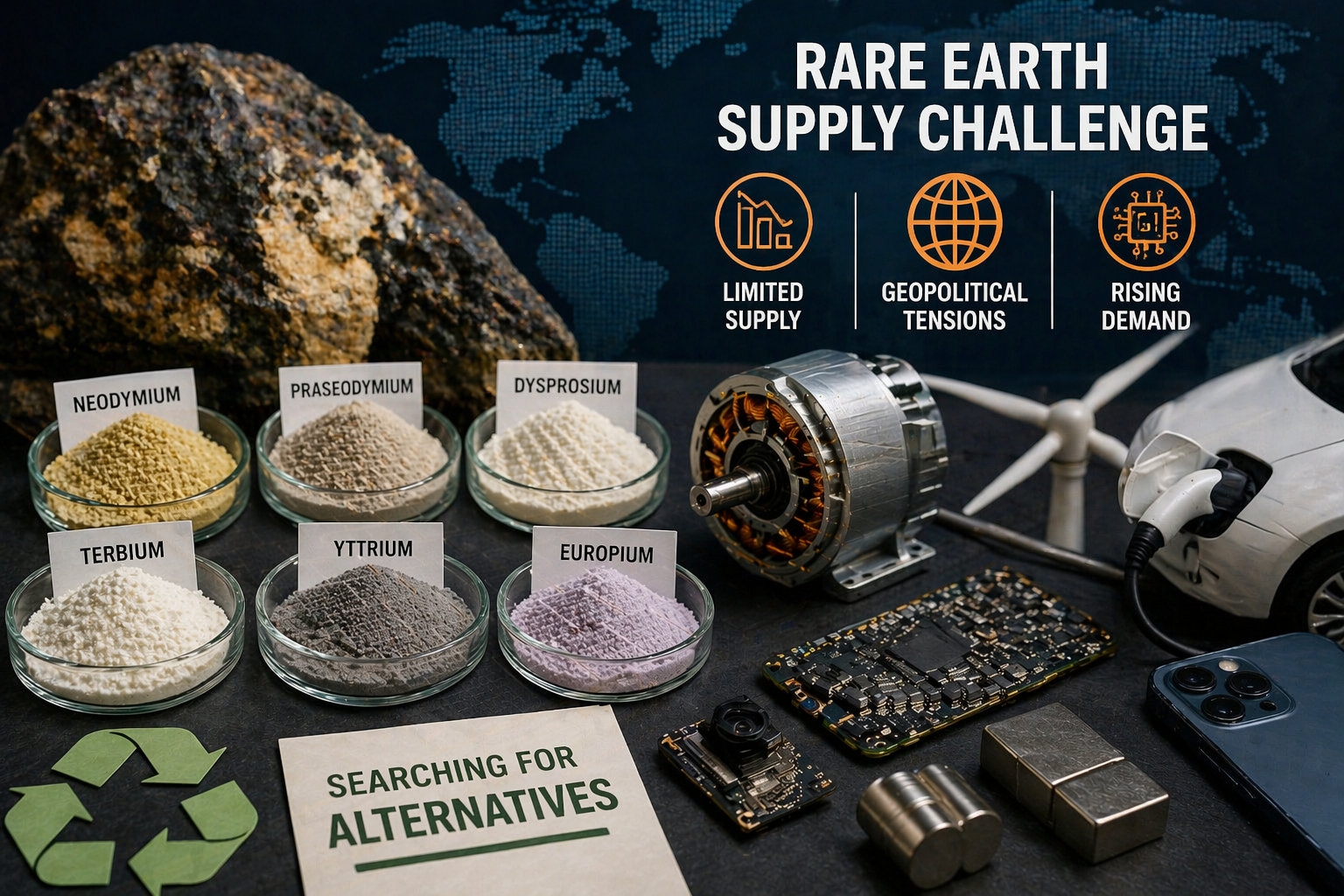
A growing shortage of rare earth minerals is pushing technology manufacturers worldwide to accelerate the search for alternative materials, raising concerns over supply chain stability and future production costs.
Rare earth elements—essential for producing smartphones, electric vehicles, wind turbines, and advanced defense systems—are becoming increasingly difficult to secure as demand surges. Industry analysts point to rising geopolitical tensions, export restrictions, and environmental limitations on mining as key factors tightening global supply.
China, which dominates a significant share of rare earth processing, has recently tightened oversight on exports, prompting manufacturers in the United States, Europe, and parts of Asia to rethink their sourcing strategies. Companies are now investing heavily in recycling technologies and exploring substitutes such as sodium-based batteries and magnet alternatives that reduce reliance on critical minerals like neodymium and dysprosium.
Major tech firms are also collaborating with research institutions to develop innovative materials that can maintain performance while reducing dependency on scarce resources. Early breakthroughs in material science suggest that viable alternatives may soon enter commercial production, although scaling these solutions remains a challenge.
Meanwhile, governments are stepping in with policy support, offering incentives for domestic mining, recycling initiatives, and research funding. Several countries have announced plans to build strategic reserves of critical minerals to buffer against future disruptions.
Experts warn that without swift diversification, the shortage could slow the global transition to clean energy and disrupt electronics manufacturing. As competition intensifies, the race to secure sustainable and reliable material sources is becoming a defining issue for the future of the tech industry. News as Reported.