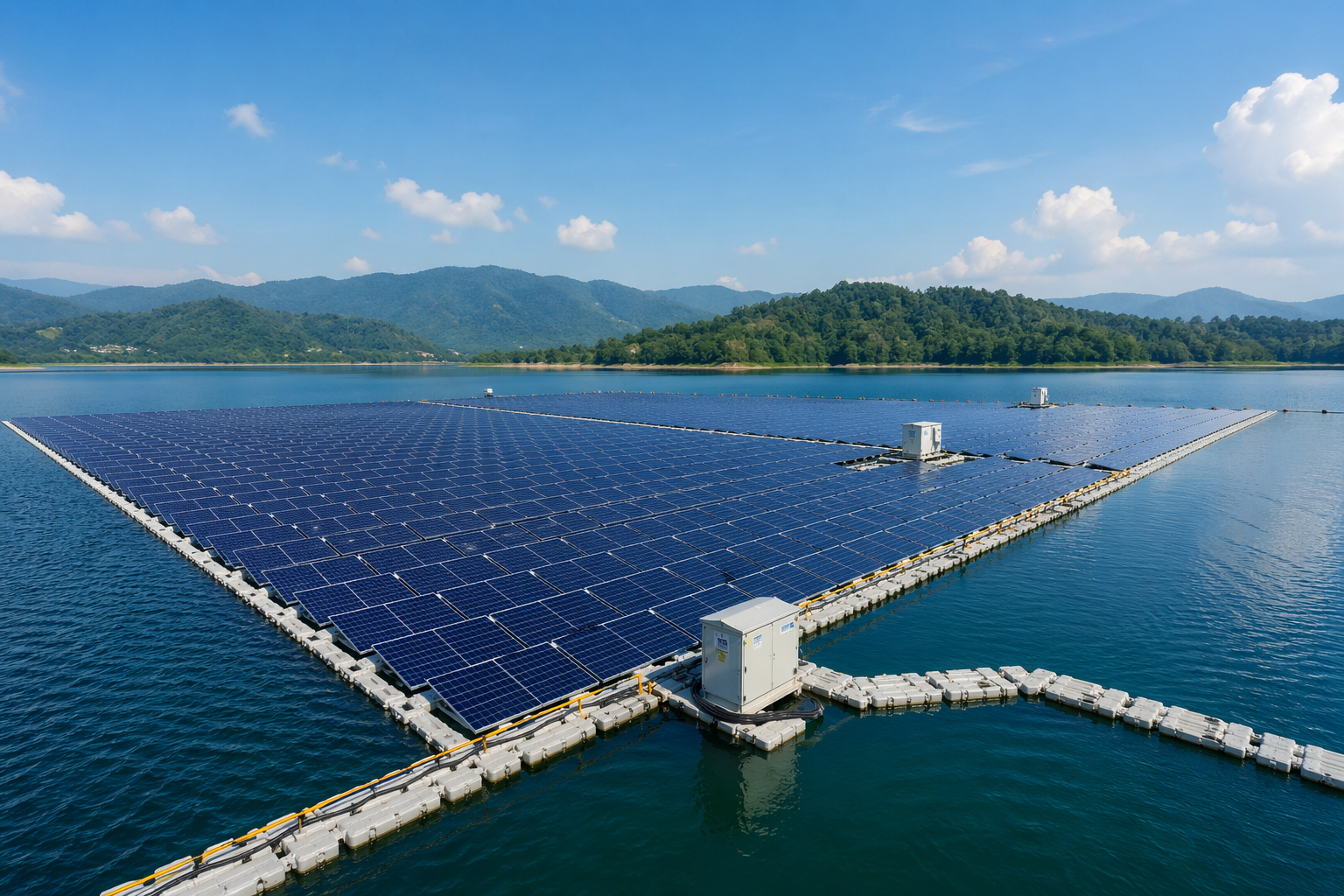
Floating solar farms are rapidly emerging as a key solution to the growing challenge of land scarcity, with countries across Asia, Europe, and Africa accelerating investments in water-based renewable energy projects.
Recent developments highlight a strong global shift. In China, one of the world’s largest offshore floating solar installations has already begun generating electricity at scale, capable of powering millions of homes. Meanwhile, Zimbabwe is preparing to launch a massive 600-megawatt floating solar project on Lake Kariba, marking a significant step toward boosting electricity supply in power-constrained regions.
Across Europe, industrial applications are also expanding. A 31-megawatt floating solar farm in Belgium is now helping power cement production, reflecting how heavy industries are adopting cleaner energy alternatives. In Asia, countries like India and Indonesia are pushing forward with reservoir-based solar plants to reduce dependence on fossil fuels and meet rising electricity demand.
Experts note that floating solar panels offer multiple advantages beyond land savings. By covering water surfaces, they reduce evaporation and improve panel efficiency due to cooling effects. Governments are also attracted to faster project timelines, as these systems often bypass complex land acquisition processes.
Market forecasts indicate strong long-term growth, with the floating solar sector expected to expand significantly over the next decade, driven by technological improvements and policy support.
As energy demand continues to rise and land becomes increasingly scarce, floating solar farms are positioning themselves as a practical and scalable solution for the global clean energy transition. News as Reported.