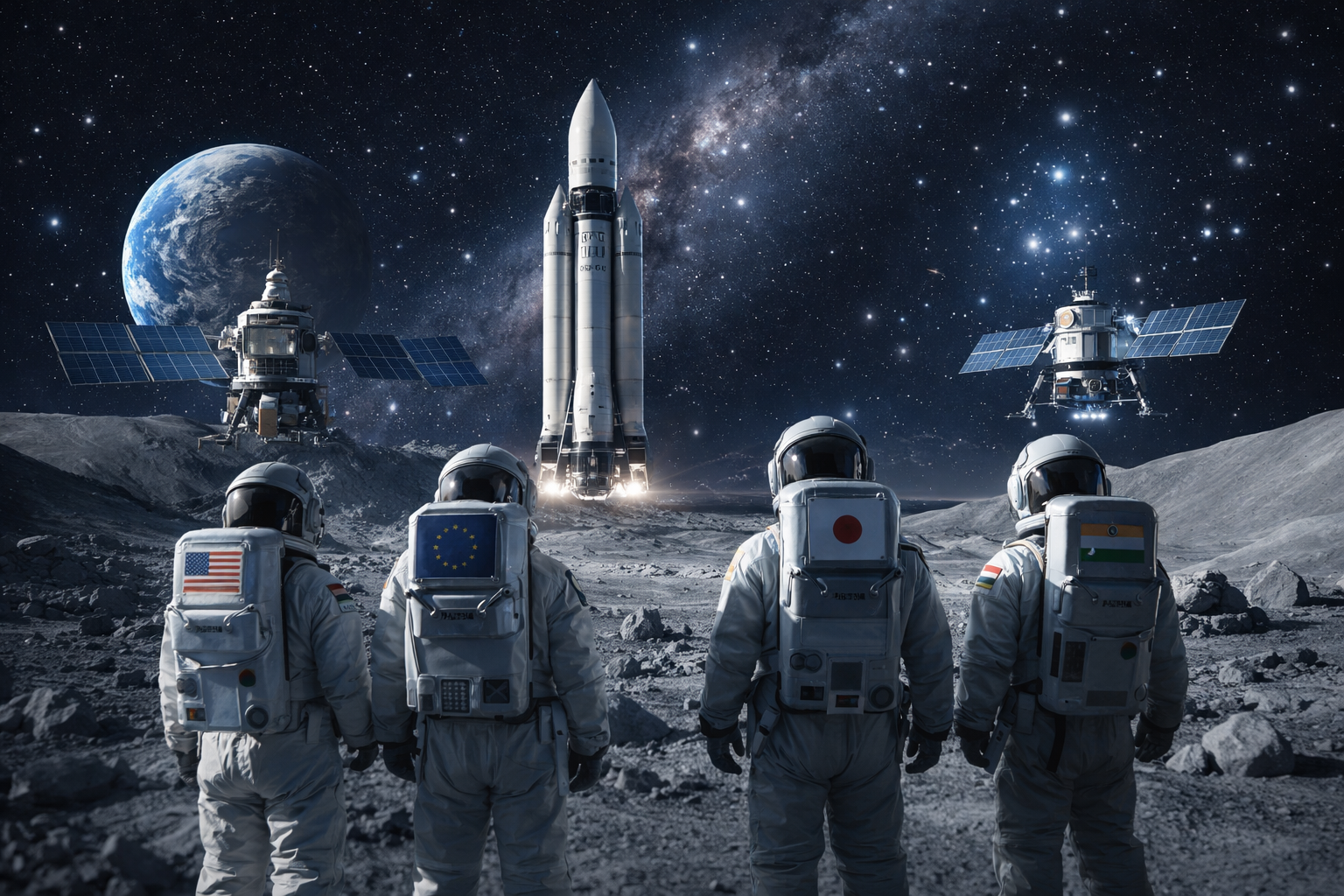
Several major space agencies have announced plans to collaborate on new missions focused on deep space exploration, marking a significant step toward expanding humanity’s presence beyond Earth’s orbit. The joint initiatives are expected to strengthen international cooperation while accelerating research on the Moon, Mars, and distant regions of the solar system.
Leading organizations including NASA, the European Space Agency, Japan Aerospace Exploration Agency, and Indian Space Research Organisation are working together on a series of coordinated missions designed to explore deep space more efficiently. Officials say the collaboration will allow agencies to share technology, scientific data, and mission costs.
One of the primary goals of these joint missions is to support future human exploration of the Moon and Mars. Several planned missions will focus on sending advanced robotic probes and orbiters to study lunar resources, deep-space radiation, and potential landing sites for future astronauts. Scientists believe these studies will play a crucial role in preparing for long-duration human missions beyond Earth.
Another key objective is to explore asteroids and distant planets to better understand the origins of the solar system. Upcoming missions are expected to collect high-resolution data, analyze space minerals, and examine environmental conditions that could support future space exploration technologies.
Space agencies are also planning to develop next-generation spacecraft capable of traveling farther and faster than previous missions. Advanced propulsion systems, autonomous navigation technology, and improved communication networks will help spacecraft operate more efficiently in deep space.
Experts say international cooperation is becoming increasingly important as space exploration grows more complex and expensive. By working together, space agencies can combine their scientific expertise and technological capabilities to achieve ambitious exploration goals that would be difficult for a single nation to accomplish alone.
If successful, these joint missions could open new opportunities for scientific discovery and help pave the way for humanity’s long-term presence in deep space. Scientists believe the upcoming decade could become one of the most exciting periods in the history of space exploration.News as Reported.